Saturday, November 28, 2009

The Big Elephant in the Room by Lane Smith

I picked this book off the shelf first because for whatever reason I thought it was going to be about politics- donkeys on the cover and its about a big elephant, I dunno. Anyway, I thought that it would be interesting to see politics from a children's book point of view. This was however, not about politics. In the end though I was okay with this because it ended up being something just as interesting. We have all heard this phrase "the big elephant in the room". It refers to something that is very obvious that nobody mentions, but everybody knows. For example, an elephant in the room would be a bad smell. It is obvious, everyone smells it, but nobody wants to mention it. Or it could be a topic of discussion that everyone knows about, but nobody brings up to talk about like a divorce or something like that. At any rate, it is a common phrase. What this book has done though is make the phrase into something that children can understand, and it does it in a funny way. It starts off with one of the friends asking, "Can we talk about the big elephant in the room?" And the other friend says "The big elephant? As in the BIG problem? I was expecting this! Because I ate all the crunchy-nut ice cream?!" He goes on asking if other things are the proverbial "elephant in the room" and finally the other friend says "No! No! No! I don't care about any of those things...I was just asking about the big elephant in the room!" Then they both look into the living room and an actual elephant is sitting on the sofa, "Oh, that big elephant! That's Stanley."

It was a very amusing ending to the story, but the more I think about it the more I wonder if it would be confusing. Maybe it would only be a good, funny ending if you already understood what the phrase meant, because the joke comes in that he wasn't being metaphorical when he asked about the elephant, he was being literal. That could also be a little confusing for younger students who didn't understand the phrase to begin with. On the other hand though, this could be a good introduction to phrases and being metaphorical versus being literal in general and in writing. Another good mini-lesson idea!

Ages 4 to 8 sayith the library and I say yay!

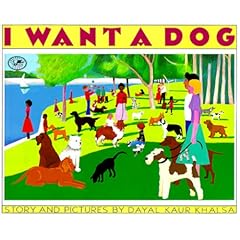
I Want A Dog by Dayal Kaur Khalsa


My original attraction to this book was the front cover because it is a re-imagining of a famous painting by Georges Seurat, Sunday Afternoon on the Island of La Grande Jatte. If I weren't going to be a teacher, I would have been an art history major, which is why this particular cover art appealed to me so much. Interesting thing though is that it is not the only major work of art featured in this book. Another is a famous Japanese block print entitled The Wave at Kanagawa.

Now on to the literary portion of this blog. All in all, this was a cute story with a good moral, but I didn't like it that much. I feel awful saying that but for some reason it just did not jump off the page for me in the same way that other books I have reviewed did. It wasn't that I did not relate to it because you could replace the main character's name with mine for most of the book and the shoe would fit. This was me last year: Meaghan wanted a dog more than anything else in the world. She thought about dogs all the time. She talked about dogs; she read books about dogs...It seemed as if everyone in the world had a dog except Meaghan. So what was it about this book that didn't click? I really don't know. Maybe it was the illustrations. They are detailed but sort of blocky. More than likely though it was how the book ended. I wanted May (the real main character) to get a dog in the end, and she did, but not in the way I thought she would. The author simply says In a couple of years, May did get a real dog of her own. Meanwhile, though, May and all her friends, kept practicing. I wanted her to get her dog right away.

This made for a morally sound story though. This book taught about not only the responsibilities that come with having a dog, but it also taught about more abstract concepts. For example, not giving up, which could be applied to more than just begging your parents for a dog. It taught about hard work when May saved up to buy a puppy. It taught about patience in that May did not get her puppy right away but she continued to show her parents what a good owner she would be. It also shows May gaining a good idea of how she will take care of her dog, and show her parents that she can be responsible by taking her roller skate for walks and such.

The library says all ages, and I agree! These lessons know no age limit.

Love That Dog by Sharon Creech

Love That Dog? How about Love That Book? That was corny but it had to be done. Yes, I did love this book. It was charming and simple, yet deep in its own right. It introduces the idea that children of all ages, or anyone, for that matter can write poetry. Which is important for children to realize. This book would be so perfect to help introduce that to students because it shows an average little boy writing poetry that his teacher loves. I think that praise from the teacher is a good example for students to see, because even though Jack thinks his poetry is silly, his teacher wants to put it up on the board. It is also a good way to approach teaching poetry to students. Putting everybody's poetry up on the board for everyone to see, leaving off names if the student so desires. I thought that it was interesting that Jack didn't want his name on his poetry just because it is not uncommon for people to write poetry anonymously. It can be such a personal thing for people, as it clearly ended up being for Jack once he became more comfortable with the emotions that were coming up about his dog and the blue car. All in all I guess my favorite part about this book was that it brought poetry down from its seemingly lofty position and bestowed it upon us mere mortals and made it seem reachable.

Now that having been said, I really enjoyed this one but I have some issues. One thought was that it bothers me in the beginning that Jack thinks that anyone could write poetry, you just have to organize it right. This is just not true. The form is not what makes poetry, it is the rhythm and the rhyme and I feel like Jack's teacher should have make a better example of that. Though, I get it, this was written from a child's perspective and he wouldn't say that, but it bugged me. Also, I don't know if some of the verse was as a child would have written it, I don't really have a good example of it, some of it was just a little too adult like. This was brought up in class, and I have spent some time thinking about this; the seemingly quick transformation of Jack into a poet. I cant decided if I think this is realistic or not. If given enough stimulation and encouragement I think it is possible that Jack started to make the transition into thinking of himself as a poet. On the other hand though, it is not always that way, students could digress easily. I know of a student who takes it in turns to feel incredibly confident and very lowly. Maybe that would have made it a little more believable.

I would totally recommend this book for a classroom, even if you are not teaching a poetry unit. For just everyday reading, students would benefit from the reading of something that is classified as a chapter book, even though it is not very long. It would help their confidence in their reading. It could also get students thinking about writing poetry of their own. Not to mention that whole making poetry accessible thing.

Wednesday, November 25, 2009

It's About Dogs by Tony Johnston and illustrated by Ted Rand

Okay so here is a smidge more bias showing, I picked this book out because theme was dogs, and I love dogs! The first thing that came to mind when I saw this book, aside from being excited about the subject, was what a great book for a student that didn't think they would like poetry but loves dogs. This would be one of those books that you could use as a platform for students who weren't sure about reading where you use the subject to entice your students. I know that when I was little I would have been all over this. Anyway, as the title would suggest, all of the poems are about dogs. They are not uniform though and I liked that about it. For example, some of the poems are only two lines and others go on for several stanzas. They are also about all different kinds of dogs in different situations. One of my favorites was this:

At The Pound


Eyes bore

deep

down to the

soul

speaking

what we cannot

bear

to know...

It was very sad, its true, but I liked it because like some of the other poems that I have read in this unit, it was not wordy but the picture was there. Reading it, I could just see those big, brown soulful eyes staring up at me. It's like I am there walking along that hallway with the cages, I can hear the dogs barking. Makes me want to give my puppy a big squeeze.

The library suggests ages 6 to 9 but really I think that these poems could be enjoyed by younger students too, even if they were just read to them. I believe that poetry is good for young students, even if they cant read it on their own yet, because it teaches about rhythm and rhyme. Plus it just sounds good to the ears, and even little ones know that.

A Rumpus of Rhymes by Bobbi Katz and illustrated by Susan Estelle Kwas

This would be such a fun book to do with younger students, it would be particularly nice in a big book setting so that all of the students could see it to participate. The really neat thing about this book of poetry is that it incorporates sounds. There are lots of action words that you would find in comic books, for example lots of EEEK! and WHACK! SMACK! THUD! I just think that little ones would have a blast making the sounds along with you while you read out loud. The other really neat thing about this book is that there seems to be a poem for every season and occasion. There is a Halloween poem, a winter poem, one about the Fourth of July and one about going to the barber. This book could also potentially be a way to incorporate instruments into your book time. For example, you could use drums or tambourines and other different types of noise makers to stand in for the different noises. I really think that so far this is my favorite of all the poetry books I have looked at. Couldn't be cuter and there are so many things to do with it!

The library says that this would be good for ages 7-10, but really I think that this one could be good for all ages. I mean, who doesn't like to make loud noises when they are supposed to just be sitting and listening?

Whatever Happened to Humpty Dumpty? by David T. Greenberg and illustrated by S. D. Schindler

The other part of this book's title is "And Other Surprising Sequels to Mother Goose Rhymes". That was important to share because it really explains the book, as does the front cover, I feel. These are almost re-imaginings of these classic rhymes because they include the original and then go on to say more about them. Or they include a short passage from the original rhyme and build on it. One interesting thing for me was that I did not know some of the Mother Goose rhymes in here, or at least not all of them. I was surprised to find some of them a little gruesome actually. My favorite rhyme in this book was both funny and a little grotesque. It is a re-imagining of Three Blind Mice.
Three blind mice, see how they run!
They all ran after the farmer's wife,
who cut off their tail with a carving knife!
Have you ever seen such a sight in your life?
As three blind mice?
The rest of the tale goes on to explain that the farmer's wife cut off the tails because they are useful around the house. It also says that she decided mouse tails weren't enough so she started cutting the tails off of all kinds of things and then...
And then one day she tried to chop
the tail off the end of a whale
but he swallowed her up instead
and that is the end of her tale.
Soo... I guess she got hers. What made this one funny though were the illustrations. They are something that would probably go right over the top of a child's head (not unlike most of the humor in Shrek) but adults would catch on. The farmers wife who decides that mouse tails are helpful around the house is none other than Martha Stuart.

Another thing that this book, and that rhyme in particular, made me think of was how grotesque children's stories used to be. I mean look at the original telling of the Grimm's Fairy Tales- totally messed up! I guess you have to consider the times though. When those were made up, nothing was being psycho-analyzed and nobody thought about "oh what will this do to my children's emotional state?" Can you imagine what the press would do to someone if they came out with all those stories today? If rhymes like Three Blind Mice weren't hailed as classics, would we think the same about them? Just a thought.

Anywho, this one is for all ages. I would watch out for any kind of sensitive material though. For example, the one where Mother Goose and her gander get sucked up by a 747 while out for a leisurely fly. Some kids might laugh, others might be horrified so you just have to know your class.

Is It Far to Zanzibar? by Nikki Grimes and illustrated by Betsy Lewin

This book was unique in a way because it used some language native to the area of Zanzibar. This was neat because, not only could you use it to help teach students about different cultures, but you could use it to teach about languages. Anyway, this whole book is poems about Zanzibar and, I assume, a family that lives there. Some of the poems rhyme and some of them do not, it is nice how they switched that up. One of my favorites was called Rainy Season, it goes like this:
Aiii! The raindrops streak our faces.
All at once, the shower chases
creatures from their hiding places.
Five goats, four ewes,
Three snakes, two gnus
And one field mouse
squeeze inside my house.
To be honest I don't know why I liked this one in particular, but I did. I think perhaps it was visual without over doing it. Sometime in poetry, the similes and metaphors can swallow the message and the scene. Here though, with just saying that the storm chases, you can picture the kind of storm it is. I personally see the rain sweeping over a wide open plain, kind of like how it does over the water in the summer time, and the animals are all scurrying for cover.
I like this book for all ages really because I feel like all students would benefit from the knowledge of another country and another language that is so different from ours. The poems are generally short, but all tell a little about the country and what life is like there.